How to Choose an Automatic BOPP Tape Slitting Machine: From Jumbo Roll to Finished Rolls
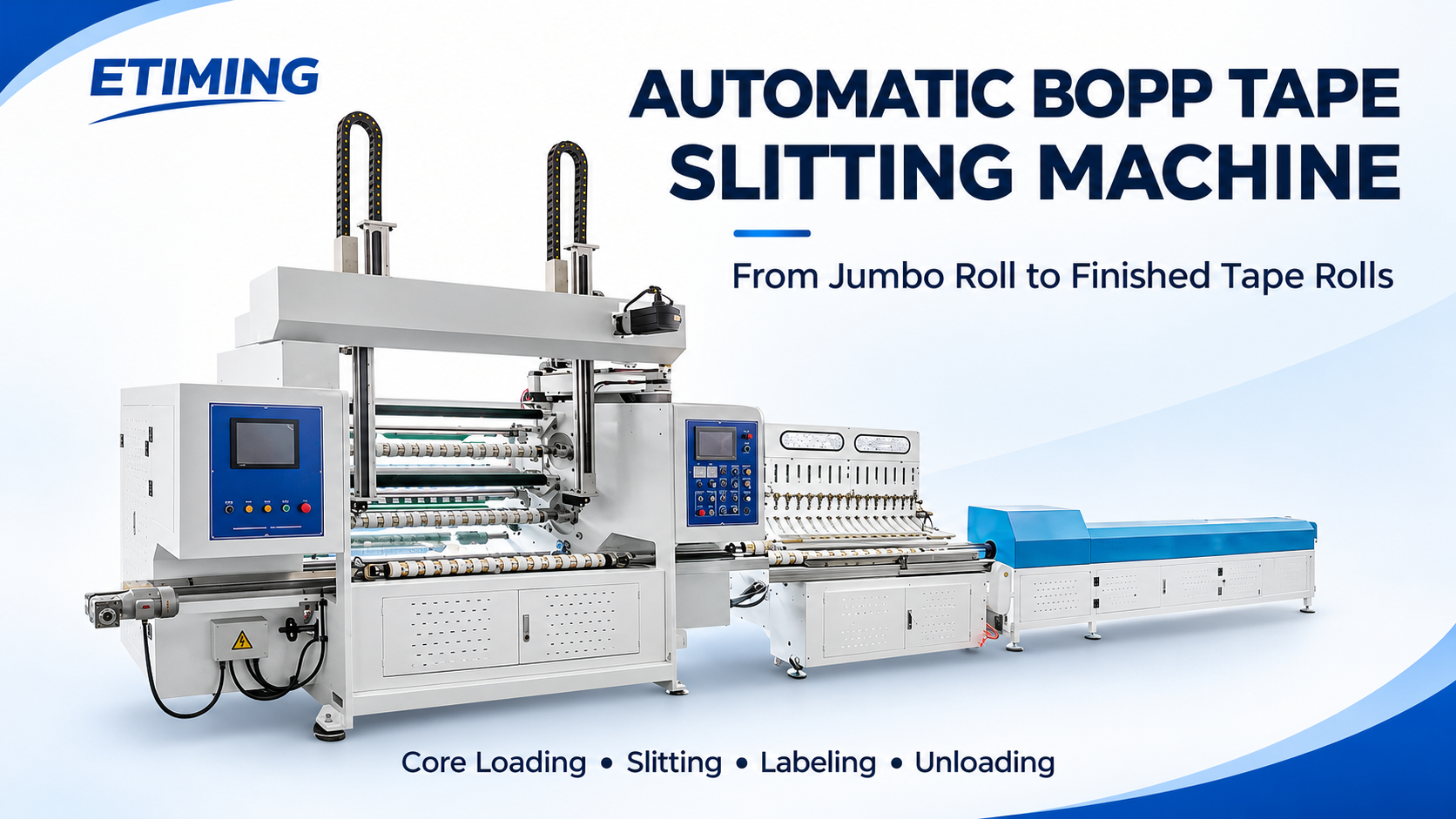
When buying an automatic BOPP tape slitting machine, first confirm whether it can handle your jumbo rolls, produce the required finished-roll sizes, and automate the operations you need.
For carton-sealing tape manufacturers, core preparation, slitting, labeling, cut-off, unloading and finished-roll conveying all affect production performance. Review these stages as a connected process.
1. How Does a Tape Slitting Machine Turn Jumbo Rolls into Small Rolls?
A BOPP tape slitting machine processes wide jumbo rolls of tape that have already been adhesive-coated.
Before production, blade positions, paper cores and the corresponding tooling are configured for the finished width. As the jumbo roll unwinds, the moving tape web is slit into multiple strips. Each strip is wound onto its corresponding small core to produce tape rolls of the required width and length.
This machine uses a four-shaft changeover slitting structure, with automatic core arranging, core loading, labeling, cut-off, tail smoothing and loading/unloading mechanisms to connect several operations in small-roll tape production.
2. Check Jumbo-Roll and Finished-Roll Specifications First
Start equipment selection with actual order requirements. The supplied machine specification lists:
Material:BOPP adhesive tape
Web width:1300 mm or 1600 mm; select when ordering
Maximum unwind diameter:800 mm
Maximum winding diameter:150 mm
Winding-core inside diameter:3 inches, approximately 76.2 mm
Slitting knives:Industrial razor blades
Maximum mechanical speed:240 m/min
Slitting machine and core-arranging/loading unit power:17 kW
Power supply:380 V, 50 Hz; customization available on request
Compressed-air supply:Above 0.5 MPa
Maximum winding diameter is an important compatibility limit. Tape thickness, core outside diameter and target roll length together determine the finished diameter. Roll length alone is insufficient to confirm whether a product can be made.
Provide the finished width, length, thickness, core dimensions and outside-diameter requirements with your inquiry. Confirm permitted jumbo-roll weight and finished-width range in the specific technical proposal.
3. How Do Automatic Core Arranging and Loading Support Slitting?
Small-roll tape production requires cores to be arranged and loaded onto the winding shafts so that core positions match the slit-strip positions.
The machine includes automatic core feeding, arranging and loading, with an automatic shaft-ejection function to reduce repetitive core-handling operations.
Before purchasing, check:
- Required core inside diameter, width and quality.
- Tooling and core-arrangement adjustments for different finished widths.
- Parts and operating steps needed when changing product specifications.
- Ease of replenishing cores and handling abnormal conditions.
Assess suitability against your usual product formats and changeover frequency. Include a specification change in the trial to understand everyday operation.
4. What Do Automatic Labeling, Cut-Off and Unloading Do?
The configuration lists automatic labeling, cut-off and smoothing mechanisms for tape-tail finishing, together with automatic loading/unloading mechanisms for handling completed rolls.
These operations work with the slitting process. During acceptance trials, use the intended tape material and check label position, cut-off quality, tail adhesion, roll end faces and unloading.
Confirm results separately for different widths, lengths and diameters. A successful trial of one specification does not establish performance for every product.
5. How Does Finished-Roll Conveying Connect to Packaging?
After unloading, finished tape rolls can be conveyed to the next station. The downstream layout reserves a connection position for an automatic shrink-wrapping machine for stacks of tape rolls.
For a complete line, define the number of rolls per pack, package dimensions, packaging format and target output before confirming conveyor and packaging integration.
The quotation should identify the supply scope of the slitting machine, core-arranging/loading equipment, conveyor and packaging equipment separately. The 17 kW value above covers the slitting machine and core-arranging/loading unit; calculate downstream packaging power separately.
6. How Should You Assess Actual Output?
The listed 240 m/min is maximum mechanical speed. Actual performance also depends on tape material, finished specifications, roll changes, core replenishment, product changeovers, unloading and packaging coordination.
Ask the supplier to run a continuous trial against your target order. Record running time, acceptable finished-roll count, reasons for stops and operations requiring an operator.
Also check roller-type edge-trim collection, broken-trim stopping and consumable monitoring in operation. Understand how abnormalities are handled and how production restarts.
These results help determine whether the equipment meets your production requirements.
Prepare These Details Before Requesting a Quotation
Provide jumbo-roll width, diameter and weight, tape thickness, finished width, length per roll, core dimensions and maximum finished outside diameter.
Also specify your usual product formats, changeover frequency, target output per shift, packaging requirements and available workshop space.
ETIMING can help review the processing range of an automatic BOPP tape slitting machine and the associated core-loading, labeling, unloading, conveying and packaging configuration. Running videos can also help you review the mechanisms in operation.
View the automatic BOPP tape slitting machine and configuration